
In July 2004, the Western Australian Government announced that it would construct one of the world’s largest seawater desalination plants to supply Perth with up to 45 gigaliters per year of potable water.
Soon after, the NSW government announced plans to build a desalination plant for Sydney on the Kurnell peninsular. Following community anxiety, the construction of this plant has been postponed. However, planning continues and construction will begin when Sydney’s supplies dip below 30 per cent of capacity. The plant will initially produce 125 megaliters per day, but will be built with the capacity for further expansion to 500 megaliters per day.
Other cities, including the Gold Coast and numerous smaller coastal towns around Australia have also begun investigating the feasibility of seawater desalination as a component of their overall municipal water supply and management.
To achieve best-quality water production, a number of alternative treatment approaches could be considered. However, in 2006 Australia, reverse osmosis membrane treatment is by far the most energy efficient approach for adequately upgrading both conventionally treated wastewater (water recycling) and seawater.
The fundamental principal of reverse osmosis is the employment of semi-permeable membranes to separate a ‘purified’ component of the water from a waste-stream retaining the concentrated salts. This waste stream is commonly referred to as the membrane ‘concentrate’ or ‘brine’. The sound management and disposal of concentrates has become one of the greatest concerns regarding both water recycling and desalination, and is often a key factor determining the overall viability of a project. The issues involved include technical challenges, permitting problems and high costs.
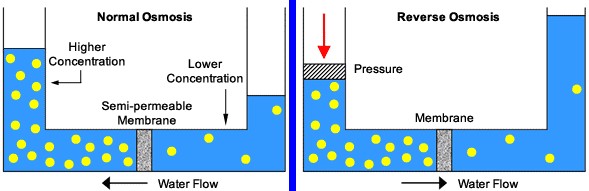
Concentrate from seawater desalination typically comprises half of the original in-take volume and almost all of the dissolved salts. Accordingly, it is typically double the normal concentration of seawater. Most commonly, concentrates are discharged via ocean outfalls, however the double salinity renders concentrate plumes denser than seawater and thus they sink and can be difficult to disperse. The potential impact of concentrate plumes on marine species in Australian environments has yet to be properly assessed.
Much public discussion has taken place regarding the relative energy requirements to treat municipal effluents and seawater to qualities suitable for reuse. Reverse osmosis technology has developed dramatically during the last decade, decreasing both the energy costs and therefore the financial costs of treatment. However, the major source of energy requirement remains the necessity to overcome the osmotic potential difference across the membrane. That is, the difference in salinity between the purified water and the retained brine.
Seawater normally has a salinity of around 35 grams per litre. Municipal effluent is typically only one tenth of this salinity. This means that the osmotic potential is lower for municipal effluent than for seawater (and a higher fraction of the water can be recovered before the brine becomes too concentrated). Therefore, considerably less energy is required to produce a volume of clean water by reverse osmosis of municipal effluent than for than to produce the same volume from seawater.
Logically, seawater is sourced from sea level (or slightly below). However, most drinking water supplies are stored inland and somewhat elevated. This helps in the gravity-assisted distribution to our homes. Therefore, a second significant energy requirement in most circumstances is the need to pump desalinated water long distances and often uphill.
Some opponents of potable water recyling in Toowoomba have left comments on this blog recomending seawater desalination as a solution for that city. One suggestion has been to allow Toowoomba to extract water from Brisbane’s Wivenhoe Dam and replace that water with desalinated seawater. The pumping costs involved with such a scheme (from the ocean, up the Great Dividing Range to Toowoomba), combined with the treatment costs would make this about the most expensive water on earth.
In addition to these obvious ‘engineering’-type limitations, some more obtuse consequences of desalination are also worth considering. One such consequence is the weakening of the message highlighting the importance of water conservation. When a potential water source is envisaged to be as great as the world’s oceans the urgency to implement water-efficient technologies and practices is reduced. Furthermore, cities that come to rely on seawater desalination rather than conservation or recycling, will also rely on ocean outfall infrastructure for the discharge of municipal wastewaters (as well as desalination brines). As these cities harvest ever-increasing volumes of water from the ocean, they must also discharge similarly increasing volumes to the detriment of Australia’s precious marine environment.
But of course, desalination does have one great advantage over municipal recycling…no yuck factor! And yes, I know…no hormones, RU486 abortion pills, prions, or other yet-to-be-invented chemicals. However, properly treated recycled water will not contain these either…
Whadda you reckon?

