
Approximately 60% of the water supplied to Perth is sourced from groundwater. Sandy areas or porous rocks which contain significant amounts of underground water are called aquifers. In some locations there can be numerous aquifers at different depths separated by impervious rock. The upper-most aquifer is known as the ‘shallow aquifer’ or ‘unconfined aquifer’ and its upper surface is the water table.
The water table tends to follow the topography of the ground surface, -rising where the ground gets higher and dropping in lower areas. As a result, groundwater ‘mounds’ tend to develop in comparatively higher areas. Where this happens, there is a slow horizontal flow of water outwards from the mounds under the influence of gravity. The horizontal flow rate is typically only 10 to 100 metres per year.
The city of Perth sits on what is known as the Swan Coastal Plain. The unconfined aquifer directly below it is known as the Superficial aquifer and is on average about 50 metres thick. The Superficial aquifer has two important mounds. These are the Gnangara mound to the north of Perth and the smaller Jandkot mound to the south. Below the Superficial aquifer there are a number of confined aquifers, the largest of which are the Leederville, which is typically several hundred metres thick, and the Yarragadee, which in many areas is more than a kilometre thick.
The Leederville aquifer is an important drinking-water source for Perth. The Superficial aquifer has also been an important water source for many decades and it is very common for Perth households to extract water directly from it for garden and lawn watering. The exploitation of this groundwater is rapidly approaching sustainable limits in some areas, causing the water table to drop markedly.
Managed aquifer recharge refers to the process of adding a water source such as recycled water to depleted aquifers under controlled conditions. Water can be added to an unconfined aquifer by passive infiltration from a pond (or ‘basin’) or by pumping it along a shallow pervious pipe or gravel trench known as an infiltration gallery. In either case, the water infiltrates down through the soil to the aquifer. Recharging a confined aquifer normally requires pressurised pumping through an injection well.
The organisation that manages Perth’s water resources is Water Corporation. They have signalled that they see managed aquifer recharge as a means of potentially supplying around 27 gigalitres per year of public drinking water injected via the Gnangara mound by 2015. The source water would be advanced-treated recycled water from Beenyup Wastewater Treatment Plant. It would then be transported via a (roughly 40 km) pipeline to a nature reserve further north of Perth. At various points en route, water would be injected into the confined Leederville aquifer or infiltrated into the Superficial aquifer.
The image below is a conceptual diagram of such a scheme showing a recycled water pipeline from Beenyup. The red crosses show possible injection points for the Leederville aquifer and the red squares show possible infiltration sites for the Superficial aquifer. Click on the image and magnify it for a better view.
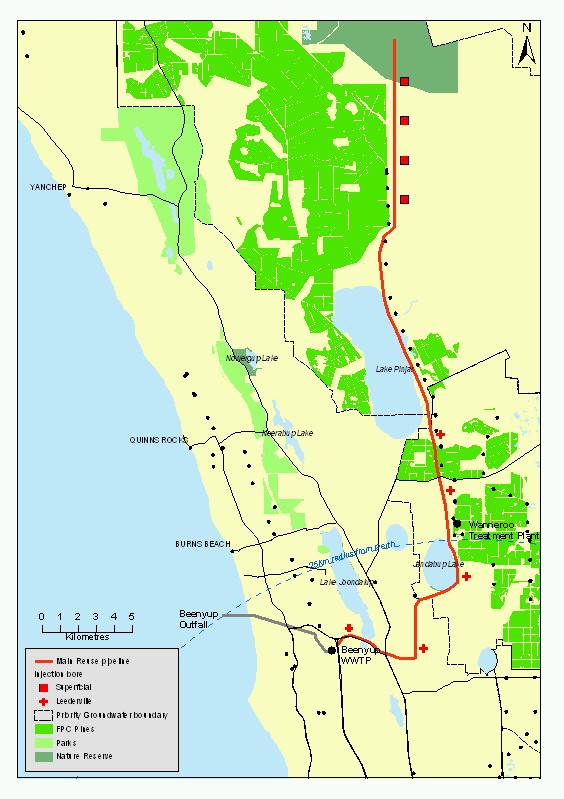 Potential Perth MAR Scheme by 2015
However, before committing to the hundreds of millions of dollars needed to build such as scheme, Water Corporation have elected to begin by the construction of a smaller trial, through which annually 1.5 gigalitres of recycled water would be injected into the Leederville aquifer at Beenyup. Before injection, the treated effluents would be upgraded to potable standard by advanced treatment including microfiltration, reverse osmosis, and advanced oxidation (probably UV). The water will then be injected to a depth of around 200 metres. Water Corporation have predicted that this water would then take a minimum of 50 years before reaching drinking-water production bores more than three kilometres away.
Detailed monitoring of water quality will be undertaken prior to injection into the aquifer and also via a number of extraction wells as the water moves horizontally away from the Gnangara mound. The monitoring program is intended to be undertaken over a period of three years.
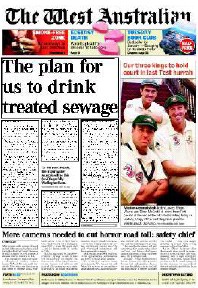 As well as demonstrating the technical feasibility, an important aspect of the trial project is to enhance community confidence in potable recycling by managed aquifer recharge. This week, the West Australian newspaper ran a front page story with the large-font headline 'The plan for us to drink treated sewage' (Warnie doesn’t look too impressed with the idea!). Personally, if I were the paper’s editor, I would have left out the word 'treated' for an even more alarmist headline. But more importantly, the accompanying article did give a good description of the proposed scheme and the role that it is expected to play as a component of future water supplies. As we have all seen, communication and the provision of accurate information to the community must be key components of planning for potable water recycling schemes.
I think this is an exciting trial which heralds a new dimension to sustainable water management in Australia. What do you think?

