
1. Size exclusion
2. Hydrophobic adsorption
3. Electrostatic repulsion
I’d like to examine this topic in a little more detail and to do so, I will introduce something known as a ‘membrane rejection diagram’. Some of this post uses some unavoidable scientific terminology...I apologise for that but don’t worry: you don’t need to be familiar with every single term in order to gain an understanding of the general concept presented.
Chris Bellona is a PhD student working with Associate Professor Jörg Drewes at the Colorado School of Mines. Bellona has spent his PhD studies closely examining which chemicals are able to pass through different membranes and which ones are rejected by the membranes. By understanding the three rejection mechanisms listed above, Bellona was able to categorise different chemicals according to their chemical properties that would determine how effectively they would be rejected by a specific membrane. The important molecular properties identified by Bellona are:
• Molecular size: The size of a molecule is often approximated by reference to its molecular weight (MW), but can be more accurately described in terms of its molecular diameter and molecular width (MWd).
• Electrostatic properties: The electrical charge of a molecule is related to how acidic it is. This is commonly described by an acid dissociation constant (pKa) and its relationship to the overall acidity of the water (pH).
• Polarity or hydrophobicity: The ‘polarity’ of a molecule determines whether it is generally very soluble in water or would prefer to partition to non-water phases. Molecules that tend to partition away from water are said to be ‘hydrophobic’. The degree of hydrophobicity is commonly described by an ‘octanol-water partitioning coefficient’ (Log Kow).
The most fundamental of the rejection mechanisms is size exclusion. This is a sieving process for which molecular size or geometry prevents large molecules from passing through the dense molecular structure presented by the active surface of the membrane. Depending on the particular membrane being used, size exclusion is believed to be the dominant retention mechanism for relatively large molecules such as surfactants, hormones, most pharmaceuticals, proteins and other molecules with MW greater than 200 atomic mass units.
However, commercial membranes vary in terms of their ability to reject molecules by size exclusion. Their ability to do so is often described by the membrane’s Molecular Weight Cut-Off (MWCO). This is the manufacture's rating of the membrane's ability to reject an uncharged dextran (sugar) based on molecular weight. Membranes with a low MWCO are commonly referred to as ‘tight’ membranes compared to those with a higher MWCO, referred to as ‘loose’ membranes.
Experiments with looser membranes (nanofiltration, ultrafiltration and microfiltration), have revealed that under some conditions, some chemicals are prevented from permeating the membrane due largely to adsorption to the membrane surface. This adsorption is believed to be due to hydrophobic interactions between relatively non-polar molecules and membranes. Such adsorptive removal may be less reliable than removal based purely on size exclusion since variations in solution pH lead to variations in hydrophobicity, and possible saturation of adsorption sites may limit total adsorption capacity if the membranes are not routinely cleaned.
Some modern reverse osmosis membranes have been designed with chemical functional groups attached to the membrane surface. These functional groups can be negatively charged, thus they repel molecules that are also negatively charged away from the membrane. They are designed to do this since it requires much less energy to reject molecules by this mechanism than it would to rely on size-exclusion alone.
By considering the combination of the properties of a particular contaminant (MW, pKa, Log Kow, MWidth), the water solution (pH) and the particular membrane (MWCO, surface charge), general rejection behaviour can be estimated by the following rejection diagram developed by Bellona and Drewes. Click on the image to enlarge for a better view.
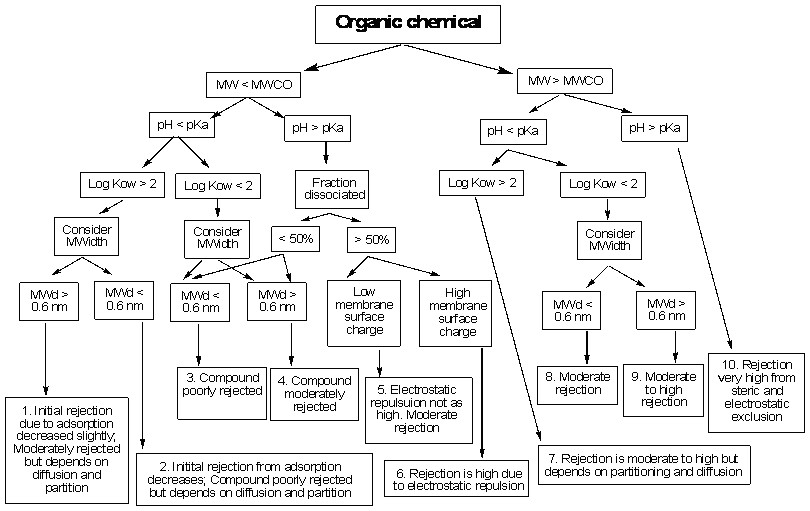
Some time ago, I went to the trouble of setting up an Excel spreadsheet that allows me to enter the properties of a membrane and a molecule and determine which of the above ten rejection categories the molecule should fall into (call me a geek, I can take it). I ran a large number of chemicals through the spreadsheet and the results were very pleasing. I found that the predicted behaviours matched reported experimental observations very well.
For example, the rejection diagram predicted that the pharmaceuticals acetylsalicylic acid (aspirin), clofibric acid, diclofenac, gemfibrozil, ibuprofen, ketoprofen, naproxen, and propyphenazone would all fall into category 10 for a membrane with MWCO 100. This predicted very high rejection is consistent with published experimental observations. Alternatively, some compounds such as 1,4-dioxane, 1,2-dichloroethane, dichloromethane and nitrosodimethylamine (NDMA) fell into category 3 indicating that they were predicted to be poorly rejected. Again this is very consistent with observed behaviour and (in the case of 1,4-dioxane and NDMA) precisely the reason that advanced oxidation was added to indirect potable water recycling schemes in California.
Of course, back in the real world things are not quite as simple as this neat rejection diagram suggests. Other important factors that contribute to rejection include the type of spacer material used to form the membrane feed channels and the system operating conditions including pressure, flow rate of water across the membrane and precise water chemistry. For this reason rejection data determined in simple lab scale experiments should be interpreted cautiously before drawing conclusions on full scale plant performance because the conditions under which the membranes operate will be different.
During normal operation, membranes are prone to fouling by the build-up of precipitated chemicals retained by them or by the growth of biomass. Fouling can lead to significant changes in membrane surface properties and thus in the way in which the membranes interact with water and dissolved contaminants. In many cases, fouling is regarded as a hindrance since it decreases membrane porosity and thus requires elevated pressures to maintain the flow of water across the membrane.
However, recent investigations reveal that fouling can also lead to improved rejection of many solutes. This observation is believed to be due to a number of factors including partial pore-blocking (thus effectively reducing the MWCO). Other factors may include increased negative surface charge leading to increased electrostatic rejection of ionic species; and increased adsorptive capacity for hydrophobic chemicals.
Most previous studies reporting relationships between physical-chemical properties of solutes and membrane interactions have been conducted using unfouled ‘virgin’ membranes and thus their conclusions are unlikely to be quantitatively transferable to full-scale systems subjected to long-term operation. Indeed, many such studies were used in the derivation of the rejection diagram by Bellona and this must be seen as a limitation to its current usefulness.
More details regarding Bellona’s membrane rejection diagram can be found in the following publication:
Bellona, C., Drewes, J. E., Xu, P. and Amy, G. (2004) Factors affecting the rejection of organic solutes during NF/RO treatment--a literature review. Water Research, Volume 38, Issue 12, Pages 2795-2809.

